Posted by Hopwood Wendy
Practising what he preaches: The Resilience Project founder back at Stawell
Date: 11th March 2026
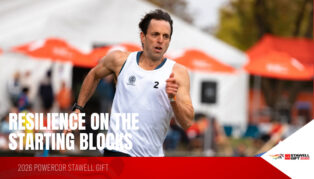
Resilience isn’t just something Hugh van Cuylenburg teaches – it’s something he practises on the starting blocks at Stawell
When Hugh van Cuylenburg stood on stage at the Sydney Opera House in front of 3,300 people last year, he wasn’t nervous.
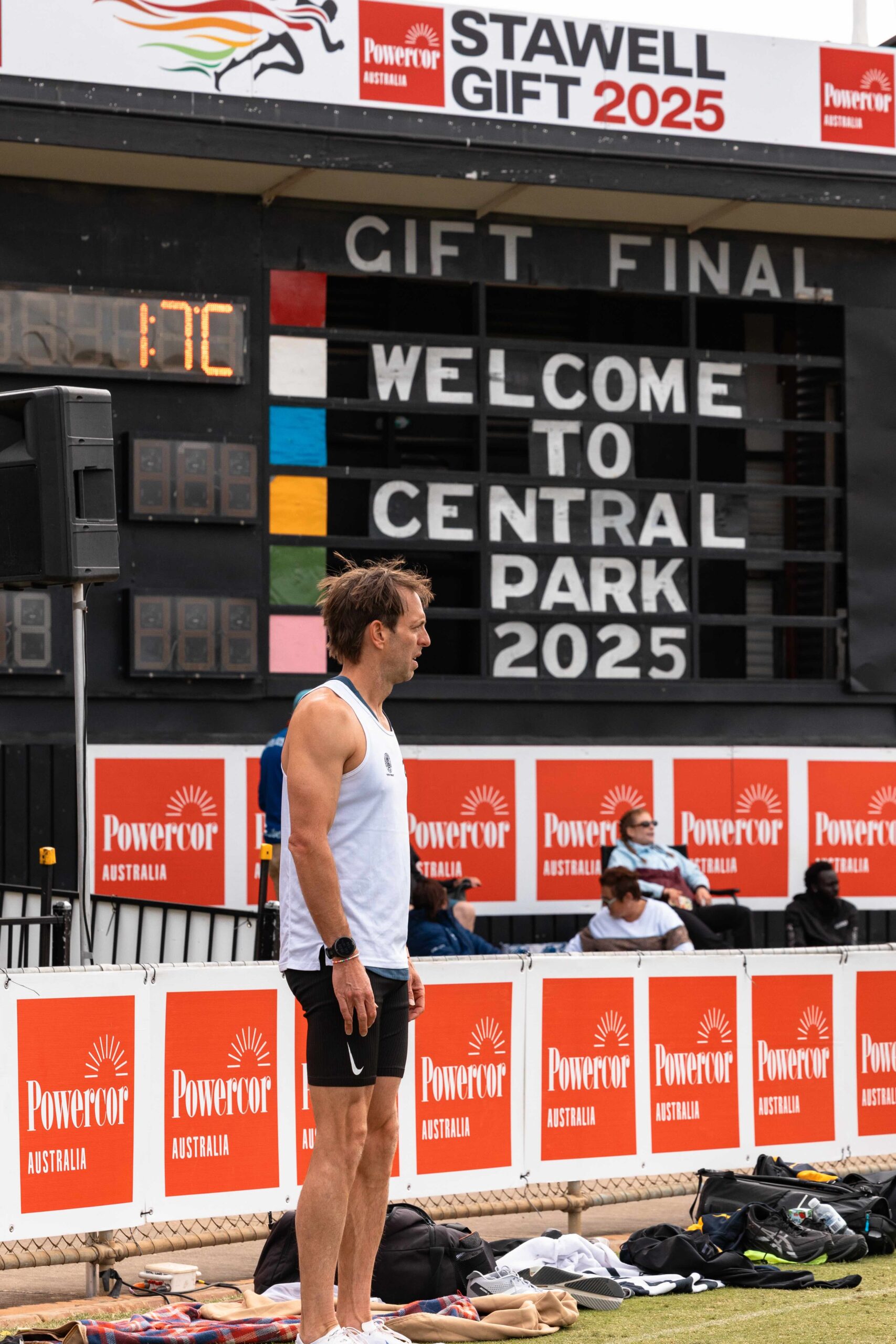
Forty-eight hours later, standing quietly in the marshalling area at the Powercor Stawell Gift with barely anyone paying attention to his race, he was.
“I couldn’t have been more nervous,” he laughs. “I remember thinking, why are you doing this? You don’t have to do this.”
For a man best known as the founder of The Resilience Project – someone who teaches Australians how to manage discomfort, stress and adversity – lining up for the Masters 300 metres at the Powercor Stawell Gift might seem unexpected. But for Hugh, running isn’t separate from resilience. It’s the foundation of it.
“I would say running, sprinting in particular, has been my main coping mechanism with the challenges life throws at us,” he says. “Gratitude and mindfulness are great, but running has been the main one.”
A three-hour drive for 300 metres
Last year was Hugh’s first time competing at Stawell after 44 years spectating from afar. “It wasn’t even really a bucket list item,” he says. “I just loved watching it. Then someone suggested I should do it and I thought, actually, I could.”
So he drove three hours to run 300 metres – and three hours home again. “I didn’t get past the heats, but it almost felt like a celebration of the fact that running has been the thing that’s got me through.”
Now he’s back for more.
The joy of running fast
Hugh played cricket and football after school, but athletics was the one that lingered. “Behind the oval at Melbourne Uni where I played cricket for 15 years was an athletics track,” he says. “Every Saturday I’d look at it and think, I wish I was doing that.”
At 35, he stopped playing cricket and asked his wife to time him over 400 metres. “She said, what do you reckon you ran? I said 53 seconds. She said, a minute nine.” He laughs.
“I thought, maybe this isn’t for me. But I just love the feeling of running fast. It connects me to childhood. At primary school it was always about who was the fastest kid, and I still love that feeling.”
Now Hugh trains with Commonwealth Games gold medallist Brendan Cole, Olympic champion pole vaulter Steve Hooker, and high-level Masters 400m/relay runner Simon Glendinning.
The foursome notably attempted to break the Australian Masters M40-45 4x100m national record, narrowly missing it at Zatopek due to, Hugh recalls, terrible weather conditions.
Hugh competes in the Masters 300 metres, last year at Stawell off an 11-metre handicap.
He’s yet to make a final, something his wife is secretly pleased about, given they have three children under nine. “If I made a final I’d be out all day,” he says. “This way I pop out for a few hours and I’m back.”
The resilience test
For someone who spends his life teaching resilience, how does it feel to put himself on the line?
“I think resilience is bungy jumping through the pitfalls of life,” he says. “And running gives you exposure to little setbacks – injuries, disappointments, things not going right. It’s good practice for life.”
The nerves, he admits, are real. “Every race, I wake up nervous. In the blocks I’m thinking, why are you doing this? But afterwards? I’m flooded with positive emotion. I’ve done something that made me uncomfortable and I didn’t pull out.”
Gratitude on the start line
Hugh often tells audiences about practising gratitude. He admits he hasn’t quite mastered it in the blocks yet though he draws inspiration from Carl Lewis, who once said he looked at competitors and felt grateful for them pushing him.
“I do think about the volunteers,” Hugh says. “I look around and think I’m so grateful for these people. They don’t have to be here.”
After 20 minutes of training, the noise in his head fades. “It’s like mindfulness. I stop thinking about work problems. By the end, I’m flooded with gratitude that my body can still do this.”
What makes Stawell special
For Hugh, who grew up in Melbourne but had never attended country sport, Stawell was eye-opening.
“It felt like a celebration of human beings at their absolute best,” he says. “There was this shared joy. Everyone is happy for everyone. And you don’t get to experience that much these days.”
He remembers feeling the history of the place, even learning a family member had once won at Stawell decades ago under a false name when amateurs were forbidden from running for prize money. “But they were cheating,” he grins.
If injury stopped him racing, he says he’d still return. “I’d still come and sit in the stands. There is something very special about it.”
Putting Stawell setbacks into perspective
With a family life that has brought both joy and challenges, Hugh keeps perspective. “Setbacks at Stawell are tiny in the scheme of things,” he says. “I’m just lucky to be in my mid-40s and still able to run fast – fast-ish.”
And perhaps that’s why he is coming back. Not for the final and not for the sash.
But for the chance to feel nervous, run hard, and remind himself, and others, that resilience isn’t just something you talk about.
It’s something you practise.
Hugh van Cuylenberg is an Australian educator, author and wellbeing advocate best known as the founder of The Resilience Project, which delivers mental health programmes to schools, workplaces and sporting clubs nationwide.
A former primary school teacher, he launched the initiative after studying resilience in remote India. The organisation now reaches hundreds of thousands of Australians each year, promoting gratitude, empathy and mindfulness.
He is also the host of the popular podcast The Imperfects, a best-selling author, and a regular keynote speaker at major events nationwide. Beyond his professional work, Hugh is a passionate Masters 300m runner and Powercor Stawell Gift competitor, using sprint training as a personal outlet for resilience and wellbeing.
Hugh was nominated for Australian of the Year in 2025.
www.theresilienceproject.com.au
https://theresilienceproject.com.au/the-imperfects-podcast/
Images by Ben Levy
Comments are closed.


