Posted by Hopwood Wendy
Allen Pollock – 50 Years Since a Stunning Stawell Triumph
Date: 25th February 2026
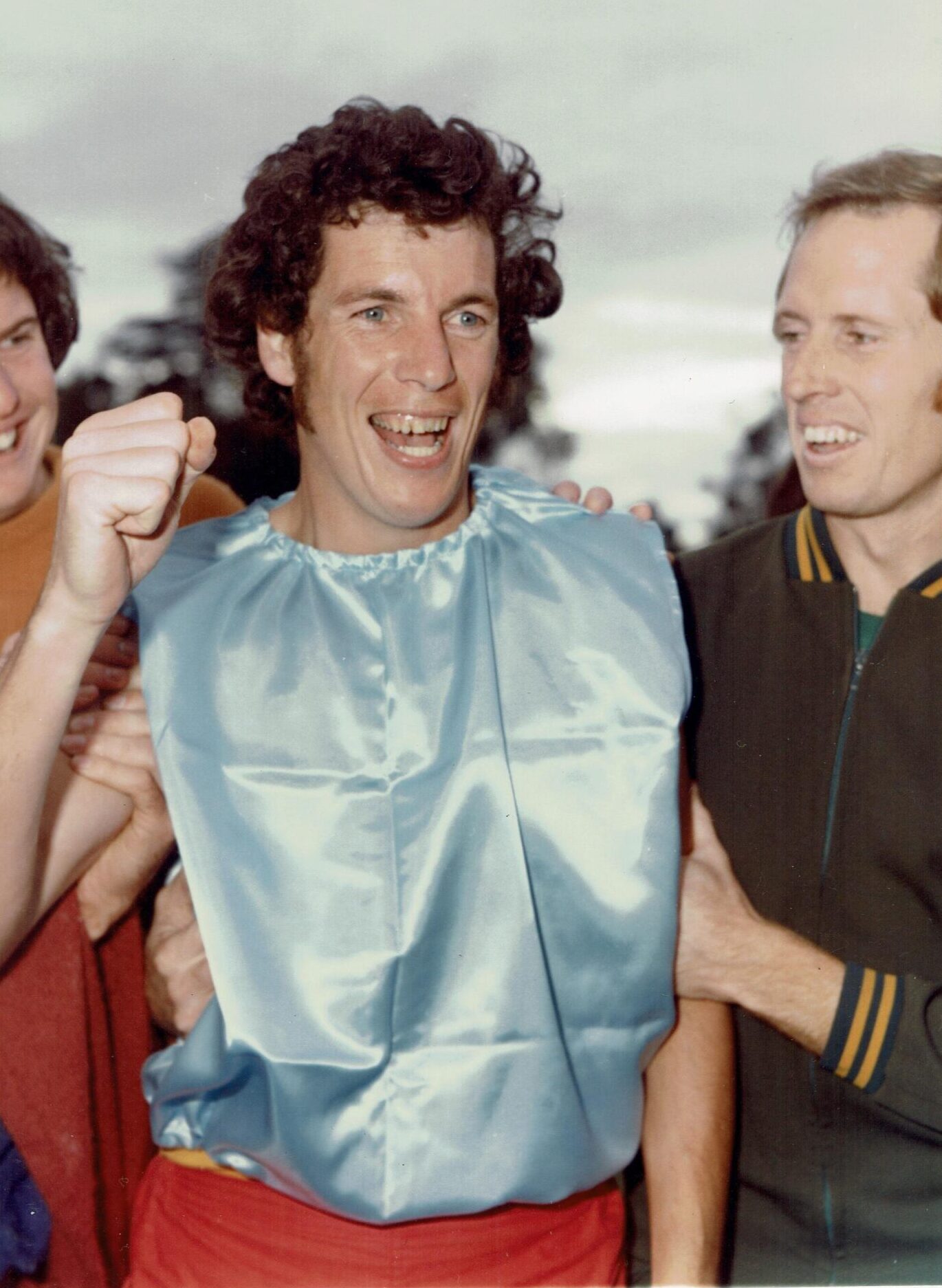
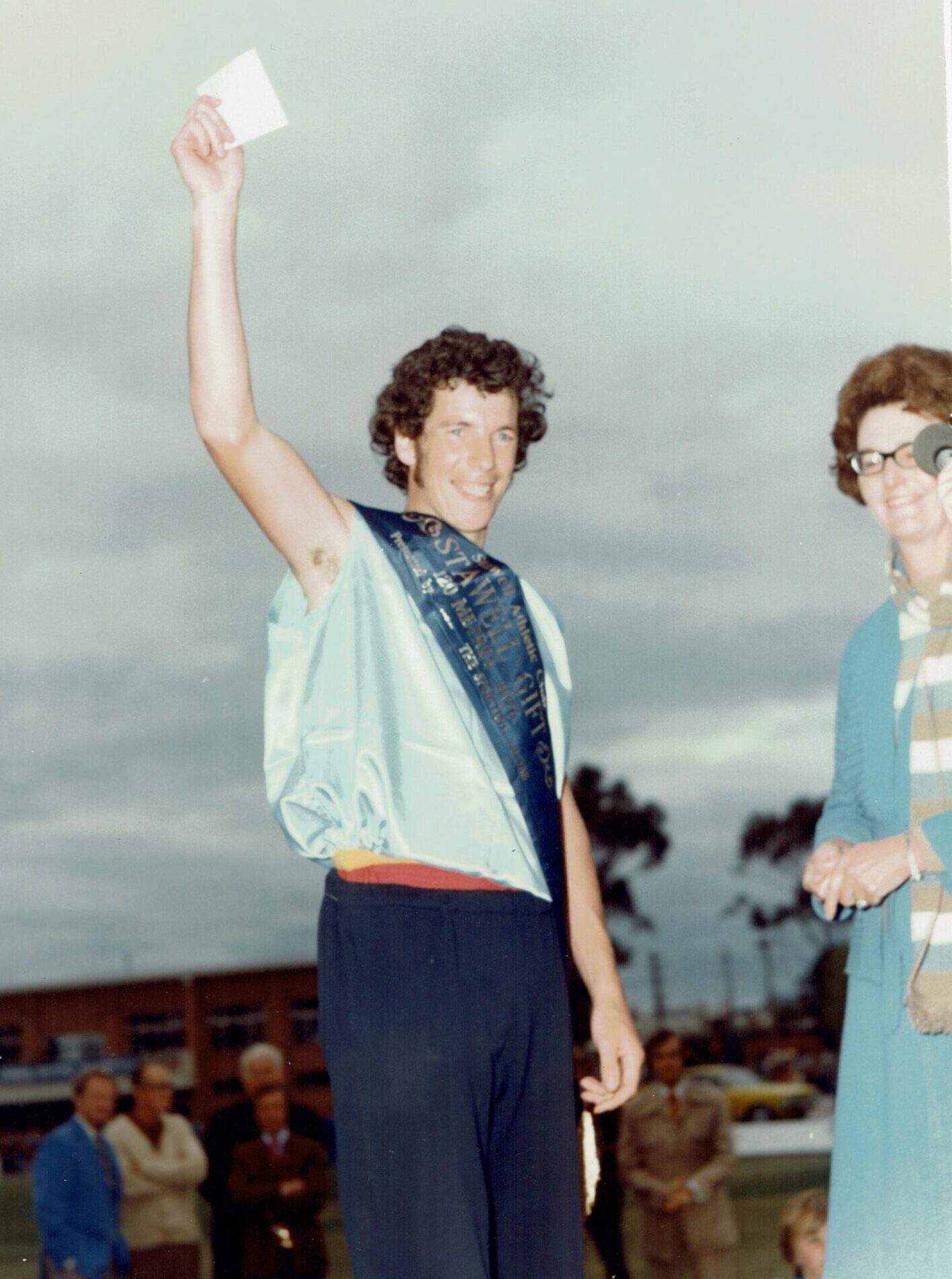
Fifty years ago, Allen Pollock arrived at Central Park for the first time. He left as the 1976 Stawell Gift champion, in what was to be one of the big upsets in the race’s long and storied history.
“It was my first visit to Stawell,” Allen recalls. “I wasn’t there to have a look around. Spainy had set me for that race.”
“Spainy” was Jim Spain, the astute trainer who had already tasted success at Stawell with Treva McGregor in 1971. Allen Pollock’s journey into professional running began when Spain spotted him at (Aussie Rules) football training.
“I started running with Jim Spain’s stable in 1970 after he spotted me at footy training for Fairfield,” Allen says. “Jim won with Treva McGregor in ’71. He knew what it took.”
Not long after, Pollock’s running was interrupted by National Service. “I did 18 months up in Queensland at Enoggera,” he says. “Our squadron was supplying reinforcements to Vietnam but that was called off.”
When he returned to Melbourne in late November 1972, he focused mostly on the 400 metres. But Spain had bigger plans.
“I ran a few sprints and Spainy decided to set me as the ‘hope’ for ’76. We did a trial down by the Yarra. Spainy showed me the time – a little under 12.00. Nice.”
Before Stawell could be the target, there was work to do. Allen needed to win a novice race to establish himself properly in the ranks. “We selected (the) Burramine (Gift). But I was not allowed to win by too much,” he says with a smile.
The strategy was meticulous. Before the novice final, money went down with bookmaker Snowy Edwards. “We got 14/1. I elected to put $100 on the betting. My handicap was 8.25 but I got a lift of a quarter metre for Stawell.”
It was the art of professional running in the 1970s – careful planning, controlled performances, and faith in the big stage.
Allen drove up to Stawell on the Thursday before Easter, staying, as many runners did, in local homes. “We used to stay with Mrs Holloway, just over the train tracks,” he says. “The person who was the ‘goer’ should have the separate bedroom. But I had been in the boys’ room for about four years and decided to keep my bed in with the boys.”
If he carried expectation, he did not carry nerves. “I was a bad starter,” he admits. “I used to stand up and then start running.” He did exactly that in his heat, running 12.3 seconds. In the semi-final he improved sharply to 12.0. “King ran the same time. I was confident after that.”
Neil King was the hot favourite. According to the Stawell Gift Almanac, King – a former Essendon Reserves footballer – was heavily backed at the bookmakers. His trainer, ‘Butch’ Roberts, rated him the best runner he had taken to Stawell in search of the “big one”, despite having prepared Barry Foley to win two Gifts earlier in the decade.
On paper, King was the man to beat. On the track, Pollock had other ideas. Treva McGregor and 1974 winner Peter Durham acted as his minders on the Monday.
“I had no nerves leading up to the final,” Allen says. “I was so relaxed I nearly missed the call-up when you sit and wait for the run down the lane from the finish. I was about to put my blocks in but the minders sent me down.”
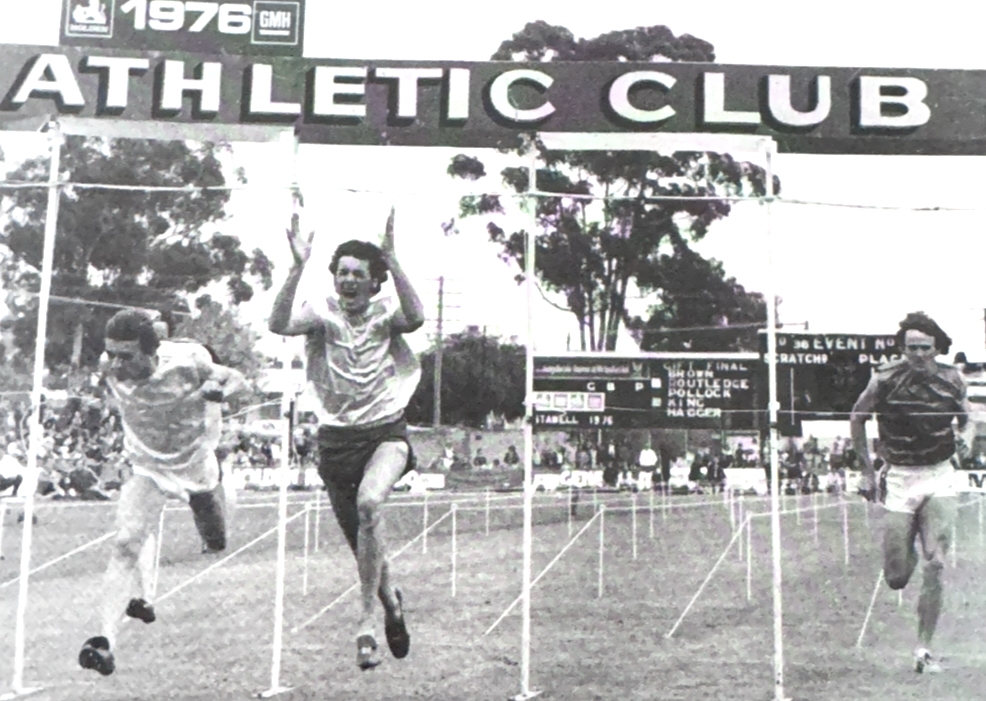
Then came the moment. “Ready. Set. Bang. ‘Keep your head down’ that was my main thought,” he says. “Head down. I looked up after 20 metres and he was still there. Only one metre. I knew then that I had it won. Ran past him. Did not even think about the others.”
From lane three, Pollock ranged alongside the favourite in lane five. In “one of the biggest upsets in Gift history” (Almanac), he surged clear. King led early, but Pollock powered past him, the heavily backed favourite unable to respond. The Stawell Gift was his.
Remarkably, Allen would only compete in two more Gifts, the last in 1987 at age 38. He has not been back to Central Park since, but is planning to be there this year for his 50th anniversary.
“I was never a good spectator,” he says. “I always preferred to run, than watch.”
The 1976 victory opened doors and broadened horizons in ways he could scarcely have imagined. “I had booked my flights to London for June of that year,” he says. “Travelled around the UK and Europe.” In Munich, at the beer festival, he met Wendy, now his wife.
“We bought motorbikes and travelled down as far as Greece,” he says. “Then back to London and decided to ride overland on one bike, a Kawasaki 900Z1B.”
Their journey took them through Europe, Turkey, Iran, Afghanistan, Pakistan and India before flying on to Bangkok and Kuala Lumpur. “We got to Melbourne just in time for Christmas. Eight dollars left in the wallet.”
Back home, the Stawell Gift again proved its value. “I applied for a job where Jack ‘Roughnut’ Irvine, the VFL umpire, was the HR manager,” Allen recalled. “As soon as he saw my name I got the job.”
He continued running, even winning the backmarkers race at the VFA final. “Just pipped (Peter) Norman, Olympic silver medallist,” he says.
In 1987, seeking a different life for his family, Pollock moved to New Zealand. “I wanted to go and live in NZ. I thought my two children, David and Claire, would be better off there,” he says. “So we moved over to Christchurch.” He ran amateur races across the Tasman and still holds a 400-metre record there.
Today, Allen and Wendy are retired, dividing their time between home and their holiday house at Kaiteriteri, at the start of the Abel Tasman Track. “We go boating, walking and caravanning,” he says.
But the 1976 Gift is never far away. The silver coffee and tea service presented to the winner sits proudly in their home.
“The coffee and tea service are pride of place,” Pollock says. “Anybody who comes visiting always asks what it’s about and I have no hesitation in regaling them with my story.”
Half a century on, that story remains one of bold planning, calm execution and supreme belief – the first-time visitor who upset the favourite, kept his head down, and knew after 20 metres that the Stawell Gift was his.
Link to video of the 1976 Final: Allen Pollock wins 1976 Stawell Gift
Comments are closed.


